Future-Proofing Architecture: Designing for Climate Change Resilience
The global construction industry faces a twin responsibility: drastically cutting its carbon footprint (mitigation) and simultaneously building structures robust enough to withstand the volatile future of our planet (adaptation).
Buildings are not just victims of the climate crisis; they are major contributors, accounting for almost 40% of global energy-related carbon dioxide () emissions.
Therefore, the evolution of modern architecture from basic shelter to climate-responsive, self-sufficient systems is arguably the most critical design challenge of our time.
This comprehensive guide delves into the foundational principles and advanced technologies required to construct truly climate-resilient buildings, ensuring longevity, energy independence, and most importantly, occupant safety in an era of extreme weather events.
The Dual Mandate: Mitigation and Adaptation
Effective climate-resilient design operates on two integrated fronts:
- Mitigation: Reducing the building’s impact on the climate by minimizing Greenhouse Gas (GHG) emissions, primarily through achieving ultra-low energy consumption and using low-embodied carbon materials.
- Adaptation: Increasing the building’s capacity to withstand the unavoidable effects of climate change, such as intense heat, severe storms, flooding, and water scarcity.
A successful design must pursue both goals equally. An energy-efficient building that cannot survive a hurricane or flood is a failed project; conversely, a robust structure that relies heavily on fossil fuels for its operation contributes to the problem it is designed to endure.
Mitigation: Achieving the Near-Zero Energy Goal
The foundation of mitigation is the “Fabric-First” approach, popularized by standards like Passive House (Passivhaus) and Net-Zero Energy Buildings (NZEBs).
This strategy prioritizes the building’s envelope over reliance on complex mechanical equipment.
By drastically reducing energy demand first, the requirements for on-site renewable energy systems become significantly smaller and more manageable.
A. The Passive House Standard: The Ultimate Low-Energy Foundation
Passive House is the most stringent global standard for energy efficiency in buildings, creating structures that require up to 90% less energy for heating and cooling compared to conventional construction. The core principles create a robust, resilient system:
A. Super-Insulation and Continuous Thermal Envelope
This involves wrapping the entire structure including walls, roof, and foundation slab in a thick, continuous blanket of insulation.
The goal is to maximize the insulation’s R-value (or -value), dramatically slowing heat flow into or out of the building.
This high thermal resistance keeps the building cool during summer heatwaves and warm during winter cold snaps, even if the power grid fails.
B. Thermal Bridge-Free Design (Eliminating Weak Points)
A thermal bridge occurs where an external structural element (like a balcony slab or metal framing) penetrates the insulation layer, creating a pathway for heat transfer.
Passive House demands meticulous detailing to eliminate these bridges, ensuring the insulation layer is unbroken and preventing issues like condensation and mold growth that compromise the building’s longevity and indoor air quality.
C. Extreme Airtightness
Uncontrolled air leaks (or infiltration) through cracks and gaps are a major source of energy loss.
Passive House requires an airtightness level tested at 0.6 air changes per hour (ACH) at 50 Pascals (Pa), measured using a Blower Door Test.
This prevents drafts and energy waste, while also controlling moisture movement that can damage the structure.
D. High-Performance Glazing
Windows must be triple-paned with insulated frames to match the thermal performance of the super-insulated walls.
They are strategically sized and oriented to maximize desirable passive solar heat gain in winter while minimizing unwanted heat gain in summer.
E. Balanced Ventilation with Energy Recovery
Because the envelope is so airtight, a dedicated mechanical ventilation system is mandatory to ensure continuous fresh air.
A Heat Recovery Ventilator (HRV) or Energy Recovery Ventilator (ERV) continuously exhausts stale air and supplies fresh, filtered air, but it recovers up to 90% of the heat or cooling energy before the air is expelled.
This provides superior indoor air quality () while recovering energy that would otherwise be wasted.
B. From Passive to Net-Zero Energy (NZE)
A building that meets Passive House standards has done the hard work of minimizing demand. The final step to becoming an NZEB is matching the remaining low energy demand with on-site renewable generation.
A. Renewable Energy Integration
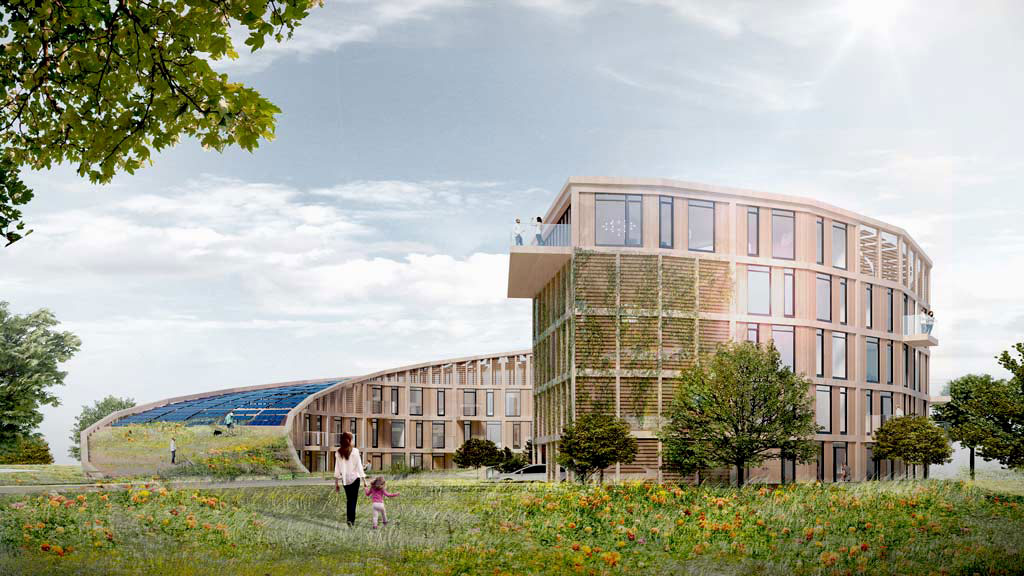
The primary solution is the integration of Solar Photovoltaic (PV) panels, optimally placed on the roof or façade, sized specifically to offset the building’s calculated annual energy consumption.
B. High-Efficiency Mechanical Systems
NZEBs rely on the most efficient appliances and systems available, such as air-source or ground-source heat pumps for heating and cooling, which move heat instead of generating it, consuming far less electricity.
Adaptation: Building Resilience Against Climate Hazards
While mitigation reduces the cause of climate change, adaptation ensures the building can physically endure the effects already locked in.
This requires a site-specific risk assessment and the implementation of robust strategies.
A. Resilience to Extreme Heat and Drought
Rising average temperatures and prolonged heatwaves pose the greatest threat to occupant health and grid stability. Passive strategies are essential for maintaining livable temperatures during power outages.
A. Advanced Exterior Shading
Shading is the most effective way to prevent solar heat gain.
Fixed and operable devices such as deep eaves, external louvers, roller blinds, and brise-soleils must be calculated based on the sun’s path to block high-angle summer sun while allowing low-angle winter sun.
B. Cooling through Vegetation (Nature-Based Solutions)
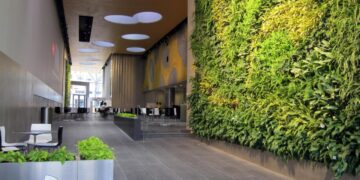
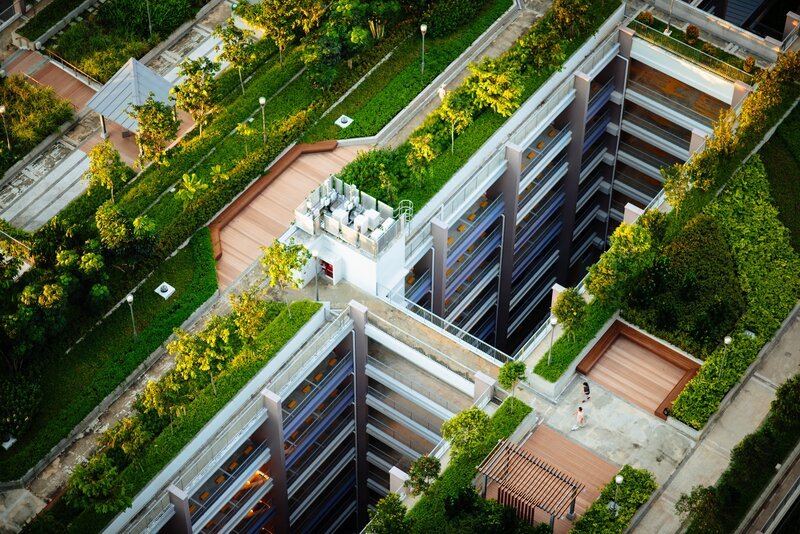
The use of green roofs and green walls (vertical gardens) provides evaporative cooling, reducing the surrounding air temperature through evapotranspiration.
Green roofs also insulate the structure and reduce the Urban Heat Island (UHI) effect, which is critical for dense city centers.
C. Water Conservation Strategies
In regions facing drought, water efficiency is non-negotiable
- Rainwater Harvesting: Collecting and storing rainwater for non-potable uses (irrigation, toilet flushing).
- Greywater Recycling Systems: Treating wastewater from sinks and showers for reuse in landscaping or cooling towers.
- Xeriscaping: Using native, drought-resistant plants to minimize or eliminate the need for external irrigation.
B. Resilience to Flooding and Severe Storms
Coastal areas and regions prone to intense rainfall must integrate structural measures to combat water ingress and high winds.
A. Elevating Critical Infrastructure
All essential building equipment electrical panels, transformers, HVAC units, and emergency generators must be located above the predicted flood level (or Base Flood Elevation, BFE), often on the roof or upper floors.
B. Structural Reinforcement and Wind Resistance
Building designs must exceed standard wind-load requirements. This includes reinforced wall-to-roof connections, impact-resistant windows, and secure foundation anchoring to prevent damage from hurricane-force winds and debris.
C. Superior Stormwater Management
Instead of relying solely on aging municipal infrastructure, buildings must manage water on-site. This involves:
- Permeable Paving: Using porous materials for driveways and walkways that allow water to filter into the ground slowly.
- Retention and Detention Ponds: Landscaping features designed to temporarily hold excess runoff, releasing it slowly to prevent overwhelming storm drains.
- Foundation Sealing: Using waterproof barriers and high-performance drainage systems to protect basements and foundations from hydrostatic pressure and water damage.
The Embodied Carbon Challenge: Materials and Construction
Mitigation is not just about the energy consumed during a building’s operation (operational carbon); it’s also about the energy used to manufacture, transport, and construct the building (embodied carbon).
A. Life Cycle Assessment (LCA) and Material Choice
Architects must perform a Life Cycle Assessment (LCA) to quantify the total environmental impact of a building, from “cradle to grave.” The goal is to prioritize materials with inherently low embodied carbon.
A. Mass Timber and Biogenic Materials
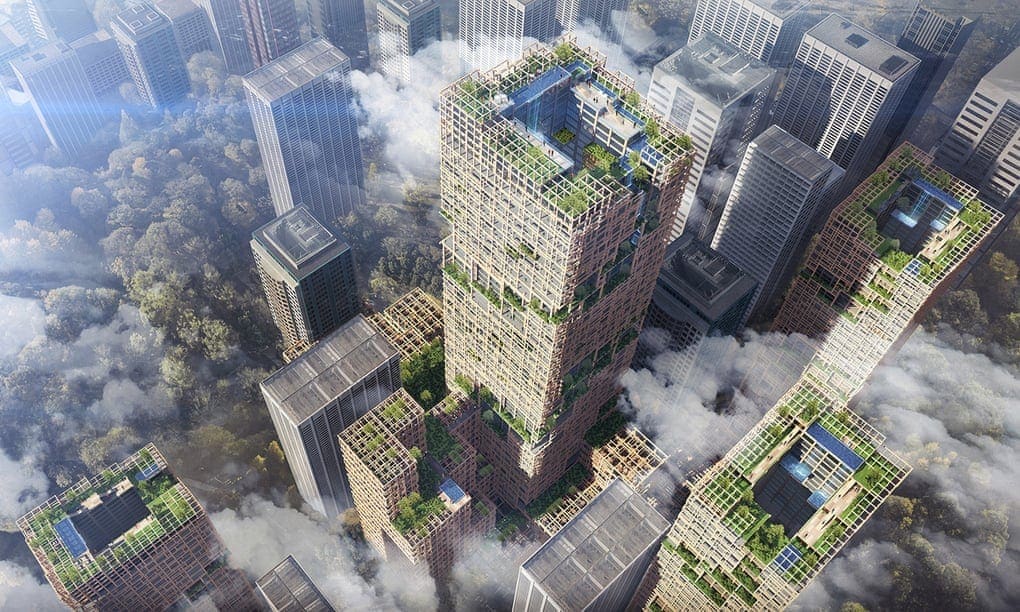
Cross-Laminated Timber (CLT) and other engineered wood products are rapidly gaining popularity because trees absorb and store () during their growth.
Using wood effectively locks this carbon into the building structure, making it a “carbon sink” rather than a source.
B. Low-Carbon Concrete and Steel
Where concrete and steel are unavoidable, designers must specify low-carbon alternatives, such as using supplementary cementitious materials (SCMs) (like fly ash or slag) to replace a portion of the energy-intensive Portland cement.
C. Reuse and Recycling
Prioritizing materials with high recycled content (e.g., recycled steel, reclaimed wood) or actively deconstructing existing buildings to reuse components (instead of demolition) dramatically lowers embodied carbon.
B. Modular and Off-Site Construction
Manufacturing components off-site in a controlled factory environment (modular construction) improves quality control, reduces material waste, and allows for more precise construction of the air-tight, heavily insulated envelopes required by Passive House standards.
This precision directly translates to long-term energy performance and structural resilience.
Socio-Economic Resilience and Future-Proofing
Climate-resilient design extends beyond engineering and materials; it involves planning for the safety and well-being of occupants and the surrounding community.
A. Decentralized Energy Systems
Equipping buildings with battery storage (like large-scale lithium-ion systems) linked to solar PV arrays allows the building to function off-grid for extended periods.
This is critical during widespread power outages caused by extreme weather, maintaining essential services like lighting, refrigeration, and communication.
B. Building Durability and Maintainability
A truly resilient design uses durable materials that require less frequent maintenance and replacement.
Simple, robust systems are preferred over overly complex, fragile technology that may fail when needed most. Designers must consider accessibility for maintenance and the lifespan of every component.
C. Health and Well-being
Resilient buildings protect occupants from environmental stressors.
The combination of filtered, fresh air from the HRV/ERV system and the stable, comfortable interior temperatures acts as a climate refuge against outdoor air pollution (e.g., wildfire smoke) and dangerous heat or cold.
Conclusion
The task of building for the future demands a permanent shift in perspective from minimizing cost to maximizing total performance and resilience.
By mandating the Passive House standard as a baseline for energy demand reduction (mitigation) and rigorously integrating localized adaptation strategies (such as floodproofing, advanced shading, and decentralized power), the construction sector can move from being a major problem source to a central part of the climate solution.
These buildings are not just safer and greener; they are more economically viable over their lifetime due to dramatically lower operational costs and enhanced asset value in a high-risk world. Future-proofing architecture is the only responsible way to build.